
Overview:
DAAN is a mobile platform designed to connect NGOs with donors and service providers. The aim is to bridge the gap between NGOs and supporters by simplifying donations, volunteering, and communication around organisational needs through a transparent and accessible experience. I used stakeholder interviews, needs assessment, and iterative prototyping to develop the platform. A pilot study with 8 participants yielded an overall mean rating of 4.14/5, highlighting positive perceptions of credibility, needs communication, and volunteering engagement, alongside opportunities for improvement.
Problem Statement
Non-governmental organisations (NGOs) require more than financial donations to sustain their work, yet connecting organisational needs with appropriate support can be challenging. GivingTuesday’s UDARTA study found that 86% of surveyed Indian nonprofits engaged everyday givers through their time and 83% through their skills, while only 37% reported actively fundraising from everyday givers in the preceding five years (GivingTuesday, n.d.). These findings highlight the importance of engaging supporters through multiple forms of contribution, rather than relying exclusively on monetary donations. However, the figures do not establish how frequently donors struggle to discover credible NGOs or how often organisational needs go unmet. This creates an opportunity to explore more connected ways of communicating needs and matching contributions with opportunities. DAAN addresses this opportunity through a mobile platform that connects NGOs with donors and service providers, bringing fundraising campaigns, volunteering opportunities, and organisational needs into a more transparent and accessible experience.

Role:
UX Researcher
Team:
x1 UX Researcher & Interaction Designer
Tools:
Figma, Excel, Miro
Methods:
Prototyping, Heuristic Evaluation, Structured Interviews
Solution
To investigate how trust and transparency shape digital philanthropy, I developed DAAN, a mobile platform concept connecting NGOs with donors and volunteers. Through interviews with five NGO representatives and five donors and volunteers, I explored how organisations communicate their needs and how contributors understand the use of their donations. These findings helped me identify gaps in the visibility of organisational needs, donation outcomes, and non-monetary contribution opportunities. Rather than treating donation as a purely transactional process, I examined how incomplete information can influence trust and decision-making. This research informed DAAN’s information architecture, user flows, and high-fidelity prototypes, which I used as a design probe to explore how clearer information and more transparent representations of resource use could support informed giving and participation.

Landing Concept
Methodology
Research Methods: Structured Interviews, Heuristic Evaluation
I adopted a user-centred UX research approach to investigate trust, transparency, and resource matching in digital philanthropy. I conducted structured interviews with five NGO representatives and five donors and volunteers to understand organisational needs, contribution practices, and barriers to trust. Through thematic synthesis of these interviews, I identified recurring challenges in communicating context-specific needs, coordinating non-monetary contributions, and providing donors with clear information about how resources were used. These findings informed the information architecture, user flows, and mid-fidelity Figma prototypes, which I developed as a design probe to explore potential ways of making giving more transparent and understandable. Rather than assuming that interface changes would improve trust, I used the prototype to investigate how interaction design could better communicate organisational needs and support informed contribution decisions.
Heuristic Evaluation
I performed a detailed heuristic evaluation of five major NGOs [UNICEF, Red Cross, American Red Cross, Akshaya Patra, CRY] and compared and contrasted the major changes that the DAAN framework could bring to their respective websites. View the detailed overall heuristic analysis here.
Prototypes and Functionalities
I used iterative prototyping to explore how DAAN’s information architecture could support the discovery of donation opportunities. The initial low-fidelity prototypes focused on core navigation and content structure, allowing me to examine how users could locate relevant opportunities. As I refined the design, I expanded the content architecture to incorporate jobs and volunteering alongside donations and NGO campaigns. I then consolidated these functions into a mid-fidelity prototype that connected different forms of participation within a single platform concept. This progression allowed me to establish the platform’s structure before increasing design fidelity, while keeping the design focused on making organisational needs and contribution opportunities easier to discover and understand.

Low Modality 1

Low Modality 2
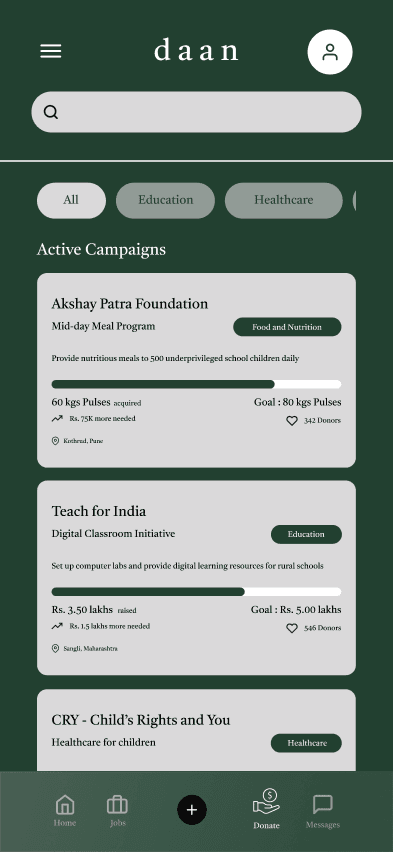
Mid Modality
Design Probe
I translated the research findings into a mobile application concept designed to explore how interaction design could make organisational needs more visible and support informed giving. Interviews with five NGO representatives and five donors and volunteers revealed differences in how organisations sourced non-monetary contributions, communicated specific needs, and shared information about donation outcomes. These findings informed a design probe that brings financial donations and volunteering and skill-based support into a connected experience. Rather than treating giving as a purely monetary transaction, I used this structure to explore how the representation of different contribution types could help align donor intent with organisational requirements. The probe provides a basis for investigating how clearer information and more accessible contribution pathways might support trust and transparency.
Core interaction structure
I organised the design probe around two complementary contribution modes to reflect the different ways NGOs seek support. The first, Donations, represents financial contributions, while Volunteering & Skill-Based Support accommodates contributions of time, materials, and expertise. This structure responds to interview findings that some NGOs relied on word of mouth or in-person outreach to find volunteers and non-monetary resources, while others used their websites. By making these contribution types visible within one platform concept, I explored how interaction design could help users discover opportunities beyond conventional fundraising. The design does not establish whether this structure improves resource matching, but it provides a concrete direction for further evaluation.
Future Directions
I would extend DAAN through a comparative UX evaluation of established international organisations, such as UNICEF and the Red Cross, and Indian NGOs to identify opportunities to improve trust, transparency, and contribution discovery. Using heuristic evaluation and task-based walkthroughs, I would examine how these websites communicate organisational needs, present financial information, demonstrate impact, and connect users with monetary and non-monetary contribution opportunities. I would compare these findings with my interview insights and design probe to identify where clearer need descriptions, stage-wise financial breakdowns, and evidence-backed progress updates could address gaps in the giving experience. Rather than assuming DAAN would outperform existing platforms, I would validate these opportunities with NGO communication coordinators and potential contributors before developing a pilot. This would help me establish a realistic value proposition for NGO partners and determine which design interventions are practical, credible, and worth pursuing.
Heuristic Evaluation: Existing NGO Websites vs DAAN
A comparative review of how established NGO websites and the DAAN design probe support trust, transparency, and contribution discovery.
Preliminary content-based comparison. A dash means the feature was not established from the available review, not necessarily that it is absent. DAAN represents the design probe, not a deployed or validated platform.
Detailed heuristic evaluation for five NGOs
References
1. American Red Cross. (n.d.). Make a difference with the Red Cross. https://www.redcross.org/volunteer/become-a-volunteer/make-a-difference.html
2. Bekkers, R., & Wiepking, P. (2011). A literature review of empirical studies of philanthropy: Eight mechanisms that drive charitable giving. Nonprofit and Voluntary Sector Quarterly, 40(5), 924–973. https://doi.org/10.1177/0899764010380927
3. Blouin, M. C., Lee, R. L., & Erickson, G. S. (2018). The impact of online financial disclosure and donations in nonprofits. Journal of Nonprofit & Public Sector Marketing, 30(3), 251–266. https://doi.org/10.1080/10495142.2018.1452819
4. Child Rights and You. (n.d.). Our financials. https://www.cry.org/financials/
5. GivingTuesday. (n.d.). Detailed findings on fundraising. https://www.givingtuesday.org/india/udarta-eg/report/fundraising/
6. GivingTuesday. (n.d.). Detailed findings on volunteer engagement. https://www.givingtuesday.org/india/udarta-eg/report/volunteering/
7. GivingTuesday. (n.d.). UDARTA:EG report. https://www.givingtuesday.org/india/udarta-eg/report/
8. International Federation of Red Cross and Red Crescent Societies. (n.d.). Annual report. https://www.ifrc.org/our-promise/trust-and-accountability/annual-report
9. International Federation of Red Cross and Red Crescent Societies. (n.d.). Donate. https://www.ifrc.org/donate
10. Mason, A. M., Baldwin, L., & Ahring, T. (2025). A multilayer, multimethod web and language accessibility analysis of US nonprofit organization websites: Considerations for the marketing and promotion of online giving. Journal of Philanthropy and Marketing, 30(1), Article e70007. https://doi.org/10.1002/nvsm.70007
11. Rossi, G., Leardini, C., Landi, S., & Piubello Orsini, L. (2024). Go beyond financial and performance information to reach donors: Designing-effective online disclosure in the perception of European community foundations. Financial Accountability & Management, 40(4), 435–453. https://doi.org/10.1111/faam.12384
12. Saxton, G. D., & Wang, L. (2014). The social network effect: The determinants of giving through social media. Nonprofit and Voluntary Sector Quarterly, 43(5), 850–868. https://doi.org/10.1177/0899764013485159
13. Shatnawi, T., & Algharabat, R. S. (2018). Investigating antecedents and their consequences of usability in online donations: The case of university students’ community services programs. International Journal of Technology, Policy and Management, 18(2), 125–154. https://doi.org/10.1504/IJTPM.2018.092296
14. Sung, J., Bock, G.-W., & Kim, H.-M. (2023). Effect of blockchain-based donation system on trustworthiness of NPOs. Information & Management, 60(5), Article 103812. https://doi.org/10.1016/j.im.2023.103812
15. The Akshaya Patra Foundation. (n.d.). Financial reports. https://www.akshayapatra.org/financial-reports
16. The Akshaya Patra Foundation. (n.d.). Nourish a generation. https://www.akshayapatra.org/nourish-a-generation
17. UNICEF. (n.d.). Take action. https://www.unicef.org/take-action
18. UNICEF. (n.d.). UNICEF transparency and accountability resources. https://www.unicef.org/
19. Wu, Z., & Dai, Y. (2024). A survey experiment on the impact and mechanisms of nonprofit transparency on donations to charities. Academy of Management Proceedings. https://doi.org/10.5465/AMPROC.2024.12277abstract
20. Give.org. (2026, June 16). Donor trust special report: Online giving platforms and donor expectations. https://give.org/donor-trust-report/2026-special-report-online-giving-platforms-donor-expectations