
Overview:
CT4PWD focuses on teaching autistic children basic computational thinking concepts through real-world applications in a gamified learning experience. The project combines a mobile app with slab-like physical cards, using interactive challenges and hands-on activities to make concepts such as sequencing, pattern recognition, and problem-solving more tangible and engaging.
Problem Statement
Donors and volunteers often face fragmented ways of discovering credible NGOs, understanding their needs, and participating in meaningful causes, while NGOs may struggle to effectively communicate ongoing campaigns, funding needs, and volunteer opportunities. Existing digital philanthropy platforms have streamlined online giving, but there remains an opportunity to create more transparent and connected experiences that bring fundraising, volunteering, and NGO engagement into a single ecosystem. DAAN explores this through a mobile platform that connects NGOs with donors and service providers, centralising campaigns, opportunities, and communication to support more informed and accessible participation in social impact initiatives.
Solution
To explore trust and transparency in digital philanthropy, I designed DAAN, a mobile platform connecting NGOs with donors and service providers. I conducted stakeholder research and translated identified needs into the platform’s information architecture, user flows, and high-fidelity prototypes, with a focus on making NGO needs, campaigns, donation opportunities, and community participation more visible and understandable. The project examines how interaction design can reduce uncertainty around giving and foster greater trust between donors, NGOs, and volunteers.

Landing Concept
Methodology
We adopted a user-centred UX research approach combining stakeholder interviews, needs assessment, and iterative prototyping. We first investigated the needs of NGOs, donors, and volunteers to identify barriers around discovering opportunities, understanding organisational needs, and establishing trust. These insights informed the information architecture, user flows, and mid-fidelity Figma prototypes, which were iteratively refined to improve transparency, accessibility, and clarity across the giving experience. Research on digital philanthropy similarly highlights accurate information, transparency, and verification as important components of donor trust.
Prototypes and Functionalities
The initial low-fidelity prototypes explored DAAN’s core information architecture and navigation, focusing on how users could discover and access donation opportunities. Through successive iterations, the platform’s content architecture expanded to incorporate jobs and volunteering, alongside donations and NGO campaigns. The final mid-fidelity prototype consolidated these functions into a broader ecosystem for discovering, contributing to, and engaging with social-impact opportunities. This progression reflects an iterative prototyping approach where early representations are used to establish structure and functionality before increasing design fidelity.

Low Modality 1

Low Modality 2
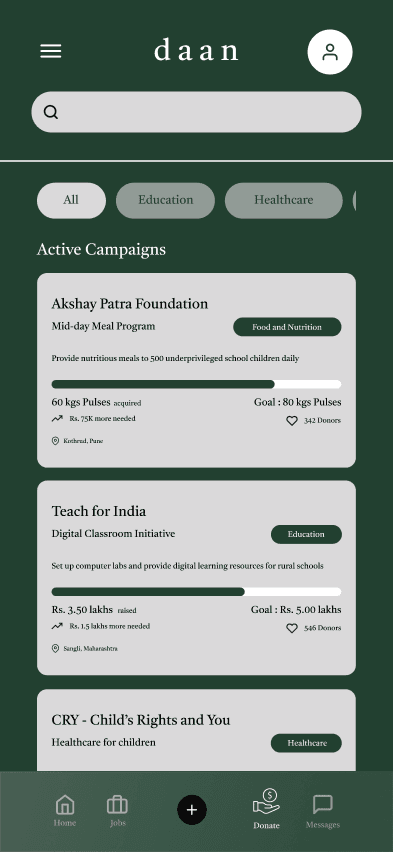
Mid Modality
Design Probe
Translating research into interaction
The application concept was developed as a design probe to explore how interaction design can make organisational needs more legible, support informed decision-making, and reduce misalignment between donor intent and real-world requirements. Rather than presenting a final solution, the probe investigates how alternative representations of need and contribution may influence trust, transparency, and perceived impact.Core Interaction Structure
The design probe is organised around two complementary modes of contribution, reflecting insights that support is not always monetary:Donations: for financial contributions
Volunteering & Skill-Based Support: for time, materials, or expertise
This structure allows the design to question the assumption that giving is primarily transactional.
Future Directions
Future iterations could explore stronger trust and transparency mechanisms, such as verified NGO profiles, clearer donation-impact tracking, and updates showing how contributions are used. These directions are supported by recent research showing that donors place importance on accurate charity information, transparency around fees and fund usage, and confirmation that charities have authorised their presence on giving platforms.
List of citations
Ghoorah Hurrychurn, U., Mariyani-Squire, E., & Zoha Amin, S. (2025). Relationships between financial transparency, trust, and performance: An examination of donors’ perceptions. Humanities and Social Sciences Communications, 12, Article 315. https://doi.org/10.1057/s41599-025-04640-2
Rossi, G., Leardini, C., Landi, S., & Piubello Orsini, L. (2024). Go beyond financial and performance information to reach donors: Designing-effective online disclosure in the perception of European Community foundations. Financial Accountability & Management, 40(4), 435–453. https://doi.org/10.1111/faam.12384